
Before knowing how to create chart of accounts for a construction company you should first understand Why a Chart of Accounts Is Important?
Chart of accounts (COA) is backbone of financial reporting and is very crucial for each business. By creating the chart of accounts, you define the nature of financial transactions that commonly occur in day-to-day business activities.
The chart of accounts is a list of all accounts organized systematically to track and categorize financial transactions. It includes unique account numbers and categorizes transactions into assets, liabilities, equity, revenue, and expenses. This list forms the foundation for financial reporting while ensuring accuracy and consistency in record-keeping.
A chart of accounts allows you to track your business activity by classifying the transactions into different accounting categories and subcategories. This way, you can monitor with more ease your assets, liabilities, and operating activities of your business.
Without chart of accounts, accurate financial reporting is impossible for any business. It not only helps to organize financial record-keeping but is also very useful in meaningfully representation of financial data.
Procedure for Creating Chart of Accounts for Construction Company
To create a chart of accounts for a construction company, you can follow below steps:
Start With a Blueprint
A blueprint provides a detailed picture and overview of your business and the project scope, this in turn results in a clear understanding of the business income and expenses. This understanding helps to categorize expenses into distinct categories, which then form the basis of the chart of accounts.
Identify Account Categories
The second step is to identify the nature of your construction business. What services is your company providing? Whether it is general contraction, real estate development, renovation, or infrastructure development, the specific type of construction service can significantly impact the structure of the chart of accounts.

It’s essential to understand the nature of your operations and the services your company provides. Different types of construction companies may require unique account categories and subcategories to accurately track financial transactions.
Customize for Construction
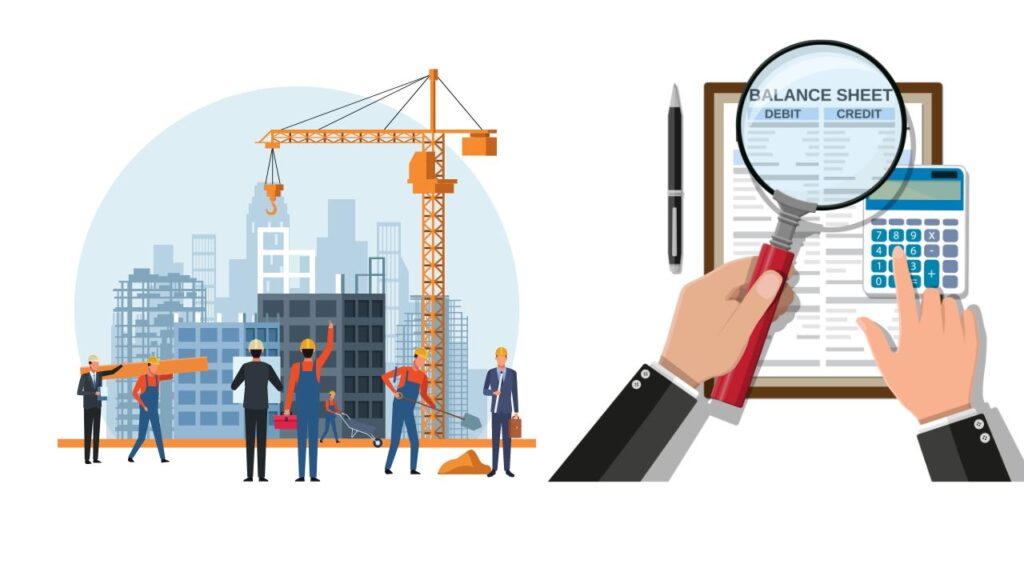
Once you have identified the categories, then customize your chart of accounts for your construction-specific needs, such as materials, labor, subcontractors, equipment, and overhead costs.
Create Sub-Accounts
Within each category, create sub-accounts to further detail transactions. For example, under the “Cost of goods sold (COGS) account,” you might have sub-accounts for “Materials,” “Labor,” “Variable overheads (VOH),” etc.
While sub-accounts make the COA structure more comprehensive it can make it complex too. So, keep a balance between completeness and complexity.
Numbering System
Assign a numbering system to your accounts for better organization and easy reference. You can assign only numbers, or you can add alphabets as well. You can also use decimals as well. However, the numbering system you use should be consistent and systematic. For example, you can start with any number series such as:
Assets account with A1000-A1999,
Liabilities accounts with L2000-L2999
Expenses account with E3000-E3999
Equity accounts with EQ4000-EQ4999,
Cost of goods sold accounts with CO5000-CO5999
Income and revenue accounts with R6000-R6999
This way, it’s easier to remember the numbering series; the letters before the number represent the major category, such as income, expense, equity, assets, or liabilities, and the numbers represent the range of that category.
Use Industry Specific Naming Conventions
Use industry specific naming conventions for better consistency and clarity. For example, use “Direct Labor” instead of “wages” or “Labor Costs” and use “Direct Materials” instead of “Material Cost.”
Also differentiate the costs according to their nature such as, mention “Fixed Overheads” or “Variable Overheads” instead of simply mentioning overheads.
Review and Adjust
Once you finalize the chart of accounts, don’t change it too often. Yes, you can add new accounts if you need, but changing the chart of accounts too often makes it difficult to compare historical financial data over time, increases errors, and disrupts accounting workflow. That’s why make adjustments that are only necessary to improve accuracy.
Consultation
Bookkeeping of a general business is easy but it becomes more challenging for an industry specific business.
Construction involves complex projects with unique accounting needs. You not only need adequate accounting knowledge but expertise in the relevant field as well. So, hiring a bookkeeping consultant familiar with the construction industry can ensure accurate bookkeeping that reflects your business activities.
At XquisiteBooks, we have an experienced team of bookkeepers that have good experience and knowledge of managing books for construction companies. So, feel free to contact us for help.
Main account categories for a construction company

The chart of accounts categories of all companies revolves around 5 elements of accounting that are Revenue, Expenses, Assets, Liabilities and Equity. The same 5 goes with COA of construction company as well. What differentiates are the accounts created under each element. Below are detailed account categories for construction companies.
Revenue
The first category is revenue account. Some people also call it an income or sales account. This represents the revenue earned by company over a specific period of time that can be monthly, quarterly or annually. Depending on type of construction business, below are sub accounts that falls under revenue account.
| Number | Account | Classification | Account Type | Recorded In |
| R100 | Revenue | Parent | Revenue | Statement of Comprehensive Income |
| R100-1 | Contract Revenue | Sub Account | Revenue | Statement of Comprehensive Income |
| R100-2 | Change Order Revenue | Sub Account | Revenue | Statement of Comprehensive Income |
| R100-3 | Retention Income | Sub Account | Revenue | Statement of Comprehensive Income |
| R100-4 | Warranty Service Income | Sub Account | Revenue | Statement of Comprehensive Income |
Cost of Goods Sold (COGS)
The cost of goods sold (COGS) account represents all direct costs associated with the construction projects. COGS mainly comprises of direct labor costs, material utilized and construction variable overheads. These costs can also include subcontractor expenses directly related to the construction activities.
A sample list of COGS accounts are:
| Number | Account | Classification | Account Type | Recorded In |
| CG200 | COGS | Parent | COGS | Statement of Comprehensive Income |
| CG200-1 | Direct Material Costs | Sub Account | COGS | Statement of Comprehensive Income |
| CG200-2 | Direct Labor Costs | Sub Account | COGS | Statement of Comprehensive Income |
| CG200-3 | Variable Overheads (VOH) | Sub Account | COGS | Statement of Comprehensive Income |
| CG200-4 | Subcontractors | Sub Account | COGS | Statement of Comprehensive Income |
| CG200-5 | Factory Plant & Mac. Depreciation | Sub Account | COGS | Statement of Comprehensive Income |
Expenses
Expenses can be categorized in different categories. You can create different levels by categorizing expenses in sub-accounts. Under each sub-account, you can further sub categorize your expenses, such as:
- E400 Expenses
- E400-1 Operating Expenses
- E400-1-1 Repair & Maintenance
- E400-1-1-1 Office repair and maintenance
- E400-1-1-2 Factory repair and maintenance
- E400-1-1-3 Vehicle repair and maintenance
- E400-1-1 Repair & Maintenance
- E400-1 Operating Expenses
You see, how you can establish different levels in the chart of accounts then subcategorize them into sub accounts. This is a better presentation of chart of accounts and will help later with tracking of expenses and in-depth interpretation of financial reports.
Different expenses for construction companies are:
- E400-1-2 Salaries
- E400-1-3 Administrative Expenses( It includes postage, landline, office rent, supplies etc.)
- E400-1-4 Selling and Distribution Expenses
- E400-1-5 Finance Charges
- E400-1-6 Marketing Expense
- E400-1-7 Insurance (It can include staff insurance, office insurance, automotive insurance.)
- E400-1-8 Depreciation Office Equipment & Furniture (Depreciation charged on office equipment and furniture.)
- E400-1-9 Other Expenses (Other rare non-recurring expenses that cannot be classified under other accounts.)
Assets
Assts are resources that are controlled and used by the entity to operate the business. Assets are mainly divided into two categories that are Non-current assets (NCA) and current assets (CA).
NCA are long term assets from which entity expects to gain benefits for a period more than 12 months and CA are short term assets that are expected to be converted into cash or consumed within a period less than 12 months.
- A500 Assets
- A500-1 NCA
- A500-1-1 Property, Plant and Equipment (PPE)- (It includes land, building , plant etc.)
- A500-1-2 Equipment
- A500-1-3 Furniture
- A500-1-4 Intangibles
- A500-1-5 Long Term Deposits
- A500-1-6 Vehicles
- A500-2 CA
- A500-2-1 Work in Progress (WIP)A500-2-2 Construction MaterialsA500-2-3 Working CapitalA500-2-4 Inventory / StockA500-2-5 Cash & BankA500-2-6 Accounts ReceivableA500-2-7 Other ReceivablesA500-2-8 Prepaid Expense
- A500-2-9 Retention Receivables
Liabilities
Liabilities are obligations or debts that the business owes to external parties. They are also mainly divided into two types that are non-current liabilities and current liabilities.
NCLs are long-term financial obligations expected to be settled in a period of more than 12 months, and CLs are financial obligations that are expected to be settled in a period of less than 12 months.
- L600 Liabilities
- L600-1 NCL
- L600-1-1 Borrowings / LoansL600-1-2 Long Term Lease LiabilityL600-1-3 Bonds PayableL600-1-4 Warranty Liabilities
- L600-2 CL
- L600-2-1 Accounts Payable
- L600-2-2 Other Payable
- L600-2-3 Accrued Expense
- L600-2-4 Short Term Lease Liability
- L600-2-5 Deferred Taxes
- L600-2-6 Bank account overdrafts
- L600-2-7 Accrued Interest
- L600-1 NCL
Equity
Equity is the funds injected into the business by owners. It represents the ownership interest held by the owners or shareholders.
E700 Equity
E700-1 Retained Earnings (All accumulated profit and loss of business is carried under retained earnings.)
Sample Chart of Accounts for Construction Companies
As I mentioned above, the chart of accounts of construction companies can vary depending on the needs and specific operations of the business. I have created a sample Excel file that represents the list of charts of accounts of a typical construction company.
Benefits of having a well-organized chart of accounts for a construction company
More Accurate Financial Reporting
Well organized chart of accounts is critical for understanding your company’s financial performance, profitability of construction projects, and overall financial health of your company.
Enhanced Cost Tracking and Variance Analysis
You can track your project costs in detail, including direct materials, overheads, direct labor, subcontractor fees, and other directly attributable costs. It also helps to analyze variance in budget estimates and actual costs, allowing you to identify areas for improvement and more accurate project bidding in the future.
Reduced Risk of Errors
The chart of accounts is the foundation of financial reporting structure of construction company. If it is not laid out well, chances are you are misreading your financial data for decision making, and your company’s growth and success might be at risk.
What Makes a Chart of Accounts for a Construction Company Unique
Tracks project-specific costs
Construction projects are unique and require tracking of costs associated with each project for accurate profitability assessment.
Includes construction-specific assets
Construction company accounts for various project materials (Like material-a, b, c), track their usage, return and wastage.
Other uncommon accounts are equipment (owned or leased), and retention receivables (money withheld by clients).
Uses COGS for direct costs
Unlike retail businesses, construction companies use the Cost of Goods Sold (COGS) concept differently. A construction COA have specific COGS accounts for subcontractor expenses , direct material and labor costs incurred on specific construction projects.
Recognizes revenue progressively
Unlike other businesses construction revenue is often recognized progressively based on project completion stages. Accounts like contract revenue, change order revenue, and progress billings are used to reflect income earned at different project milestones.

Hi, I am Basit. One of guys behind XquisiteBooks. I have been in accountancy and finance profession since last 7 years and have worked in many organizations on different executive roles. Whether its bookkeeping, financial analysis, accounts receivable, accounts payable or working with general ledgers, I have served the finance industry and gained in-depth knowledge and exposure in my domain.
If you want to know more about me or our team, check out the about us page.